
Although SAU welcomes the increase to the budgets of Regularly Funded Arts Organisations (2025 - 2026 & 2026 - 2027), it will not necessarily directly benefit individual freelance artists or independent freelance curators. There seems to be an assumption by the Scottish Government and Creative Scotland that there will be an automatic “trickle-down” type economics to artists. Unfortunately, we know that “trickle-down” economics doesn’t work.
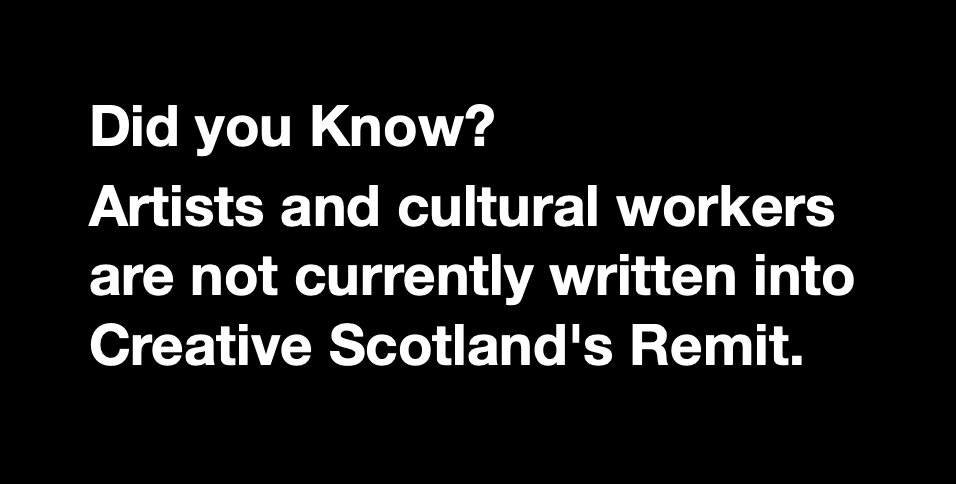
Some of the most significant problems that have been arising in arts funding provision for artists (and in Fair Work compliance) stems directly from the legislation that defines Creative Scotland's Remit. We are very concerned that Creative Scotland's current Remit (which is defined in the Public Services Reform (Scotland) Act 2010) does not directly reference or include professional artists and cultural workers at all. The current wording in the Remit is totally vague - “those engaged in artistic and other creative endeavours” - which could refer to a member of the public (of any age) attending a beginner art class for the first time. Whether intended or not, Creative Scotland's current Remit heavily skews the funding provision and decisions towards arts organisations. As a consequence, individual artists (and their practices) appear to be an afterthought. We have already seen this play out in how the Open Fund for Individuals has been treated (by both Creative Scotland and the Scottish Government).
If professional artists and cultural workers are not central to the legislation, and directly written into Creative Scotland’s Remit, then the funding priorities may ignore artists needs, and in some circumstances artists may end up being an afterthought, or potentially not on the decision making radar at all.
Throughout 2025 and 2026, SAU has been lobbying to change the legislation that determines Creative Scotland's Remit. We are proposing that the Public Services Reform (Scotland) Act 2010 be adjusted to incorporate the UNESCO “Status of the Artist Recommendations 1980”. The UNESCO Status of the Artist Recommendations are readymade and internationally recognised, and have been the basis for powerful legislation in Canada and Ireland, as well as many other countries. For example, the Irish Basic Income for the Arts Pilot is one of the outcomes from Ireland’s “Status of the Artists” legislation.
In addition to the aim of reconsidering funding priorities, if we are pushing for a solid and lasting positive change in the ‘workplace culture’ for artists and cultural workers, then embedding the UNESCO Status of the Artists Recommendations into the Scottish legislation may be a crucial component to secure/anchor the Fair Work Framework into workplaces in the Arts & Culture sectors, particularly in terms of Fair Work for freelance artists.
SAU has raised these issues at meetings with Scottish Government Ministers, in Culture Fair Work Taskforce meetings, in our evidence submission to the Independent Review of Creative Scotland, and in our 2025 Pre-Budget Scrutiny submission to the Scottish Parliament CEEAC Committee. You can see that the recommendations in the Independent Culture Fair Work Taskforce Report include these points referring to the UNESCO Status of the Artists Recommendations.
What can you do?
If you are attending any hustings events (all candidate's debates) or political party events for the upcoming Scottish Parliament Elections, or if you plan on writing to the candidates, please ask the candidates if they have read the Independent Culture Fair Work Taskforce Report, and please encourage them to support the recommendations - Thank you!
Blog post by B.D. Owens